Social activists and wildlife groups must acknowledge that no rights can
be championed, nor wildlife saved, if the forests at the centre of the tussle
vanish
The
situation is equally distressful in states such as Maharashtra, Jharkhand,
Chhattisgarh, Madhya Pradesh, Bihar, Orissa and Andhra Pradesh.
Soon after daybreak, driving through the forests of Sonitpur district in
Assam in late 2005 we made a quick U-turn when a herd of around 15-20
elephants, young ones in tow, emerged from the forest to forage right next to
the road leading to the fishing camp at the Nameri Tiger Reserve. The night
before, we watched as elephants raided paddy stocks in a village near Balipara,
unafraid of the mashaals (fire torches), drums and yells of the distressed
villagers. Even as we turned, the matriarch followed our vehicle for 20 metres
or so, trumpeting protectively from around 30 metres to make sure we got her
message loud and clear.
I know this part of India well and before my eyes, I have seen some of
India’s most precious forests sacrificed to satiate political expediency using mistaken
notions of tribal rights as a fig leaf to exchange land for votes. On a site
visit to the same area 10 years later, I found myself speechless at the sheer
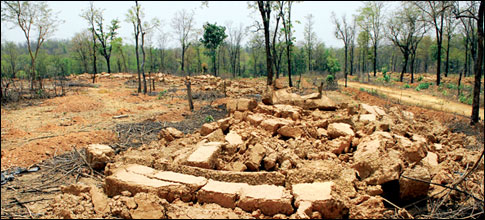
destruction. In a decade, virtually the entire standing forest on the right
bank of the Jiya Bharoli river had vanished. In its place were sparse mustard
fields and scattered tree stumps that spoke of once-tall hardwoods whose trunk
girth would have been three or four metres at the very least.
Similar stories unfold across vast areas of Sonitpur. We had predicted
such disaster when the Forest Rights Bill was being debated way back in
2004-05. We asked, at the very least, a consensus be arrived at that individual
rights not be included. A leading NGO, Kalpavriksh, amongst the most vociferous
supporters of the flawed FRA, agreed with us in principle but went forward with
other groups who threw such suggestions to the wind. Today, much too late,
Kalpavriksh agrees that a site-specific amendment to Section 3 (1) of the
Forest Rights Act (FRA), 2006, should have been made in Sonitpur to roll back
the 2005 cut-off date to 1980, “in consonance with the Forest Conservation
Act.” Subsequent to that admission, no further action was taken.
As we have seen happen time and again with urban slum rehabilitation and
regularisation schemes, the horse had bolted. The barn door was never shut.
What ails the FRA?
To begin with, the Act was intended only for tribal communities, but
this was later extended to all forest “dwellers”. Second, individual rights
trumped community rights which is evident from the statistics taken from the
website of the ministry of tribal affairs from the report on FRA
implementation. According to these statistics, people are predictably keen to
claim individual rights as this enables them to encash real estate and other
financial opportunities. Third, no time limit was definitively set. Had a
cut-off date been effectively applied, we would not be in a position where even
today “deforest, encroach and claim rights” continue unabated because gram sabhas
would have finalised all rights within two years. And the date was 1980 in the
first version of the bill.
Here is what the learned Supreme Court judges had to say in an order
passed in response to Writ Petition(s)(Civil) No(s) 109/2008 and 50/2008.
“Mr Shyam Divan, learned senior counsel for the petitioner placed before
us certain statistical data which indicates that as on September 30, 2015,
approximately 44 lakh claims for recognition of the rights under the
above-mentioned Act and grant of pattas came to be filed before the authorities
competent to deal with those claims in various states out of which some of the
claims were accepted and some were rejected. From the information placed before
this court by the petitioners, it appears, approximately 20.5 lakh claims were
rejected in the above-mentioned 44 lakh claims. Obviously, a claim in the
context of the above-mentioned Act is based on an assertion that a claimant has
been in possession of a certain parcel of land located in the forest areas. If the
claim is found to be not tenable by the competent authority, the result would
be that the claimant is not entitled for the grant of any patta or any other
right under the Act but such a claimant is also either required to be evicted
from that parcel of land or some other action is to be taken in accordance with
law.”
Nevertheless, encroachers are not being evicted even after their claims
have been rejected. What is more, most lands allotted are unfit for
agriculture, condemning claimants to work as landless labour on the properties
of richer landholders. The allotment of such lands means that the tribal
families have to survive on sustenance farming without access to water,
sanitation, health, education and medical facilities.
Even today, the cutting of trees continues. None of the cutting was or
is legal. The tribals never had and still do not have title to the land. The
elephant herds have vanished, but every once in a while, they return to raid
crops. As many as 30 were poisoned in Sonitpur by angry farmers. Neither humans
nor elephants are safe any longer. The Kameng-Sonitpur Elephant Reserve (KSER)
offers refuge to elephants, in a small measure, but almost daily, as a direct
result of human interventions, reports of “wild elephant herds creating havoc
in Sonitpur,” appear in the media.
The situation is equally distressful in states such as Maharashtra,
Jharkhand, Chhattisgarh, Madhya Pradesh, Bihar, Orissa and Andhra Pradesh.
Here, too, in order to grow food on forestlands, locals were encouraged to deforest
areas with political patronage. The objective is achieved by burning trees and
ground vegetation, then planting food crops on the ash-fertilised remains. But,
because the vast bulk of the forest nutrients are quickly washed or blown away,
such farms are incapable of offering anything more than borderline livelihoods
to farmers. This is precisely what gave rise to “marginal farming”, coined by
economists to describe millions condemned to penury. Far from creating
self-sufficiency, this has ended up eroding India’s food security, in part
because downstream farms find themselves deprived of the flood, drought-control
and nutrient-spread gifted by upstream forests.
As I write, the discussion seems Daliesque. The FRA provides a 90-day
limit for filing claims. The Act was passed in 2005 (Rules in 2007). Can we
seriously be discussing new claims even today? Surely we should collectively
agree that no limits be allowed or extended under any circumstances? Remember,
that our protected area network barely covers three per cent of our land and
acts as an insurance against climate change, floods and droughts. Under no
circumstances should such lands be open to the claim of any private rights
whatsoever. In fact, it is vital that the long-pending rules to define Critical
Wildlife Habitats be framed without further delay and that those deemed to be
encroachers vacate such biodiverse lands.
Social activists and wildlife groups must both accept that no rights can
be championed, nor wildlife saved, if the forests at the centre of the tussle
vanish. Social activists talk of “harmonious co-existence”. But I ask — can
6,000 people live in harmony in 600 sq km with 60 tigers and over 600 elephants
with the nearest market for forest produce being six km away? Given that the FRA
is a reality and without going into the merits or demerits of the legislation
itself, I wonder whether it might be possible for those living next to forests
to form cooperatives with the singular purpose of restoring eco-systems back to
health on their own lands. This may be easier said than done, but it is
possible if a basket of benefits can be channelled to communities that opt for
eco-system farming, instead of bajra, wheat or paddy. If this is achieved, the
answer to the rhetorical question “Can the Forest Rights and Wildlife
(Protection) Acts be friends?” might well be “Yes!”. But I am not holding my
breath.
The writer is editor, ‘Sanctuary’ magazine